How to Choose the Right Radiator
240mm vs. 360mm: Understanding Radiator Size, Thickness, and Cooling Performance
When building a high-performance PC, choosing the right CPU cooling solution is essential for maintaining system performance, stability, and reliability. As modern processors continue to push performance boundaries, All-in-One (AIO) liquid coolers have become increasingly popular among gamers, content creators, and PC enthusiasts.
However, with so many options available, one question often comes up:
Should you choose a 240mm or 360mm radiator? And does a thicker radiator always deliver better cooling?
The answer goes beyond simply choosing the biggest or thickest radiator.
Finding the right cooling solution requires balancing thermal performance, case compatibility, noise levels, and your actual computing needs.
240mm vs. 360mm: Does Size Really Matter?
A radiator plays a critical role in an AIO liquid cooling system. Heat absorbed from the CPU is transferred through the coolant to the radiator, where fans dissipate it into the surrounding air.
Radiator surface area and fan configuration are therefore important factors in determining cooling potential.
240mm Radiators: Compact, Efficient, and Versatile
Typically equipped with two 120mm fans, a 240mm radiator offers a practical balance between cooling capability and space efficiency.
For mainstream gaming systems, everyday computing, and compact PC builds, a 240mm radiator can provide sufficient cooling performance while leaving more flexibility for component placement.
It is an excellent option for users looking for effective cooling without sacrificing valuable chassis space.
360mm Radiators: Greater Cooling Headroom for Demanding Systems
Featuring three 120mm fans, a 360mm radiator provides a larger heat-dissipation area than a 240mm radiator.
This expanded surface area offers greater potential cooling capacity, making it particularly attractive for high-performance processors, demanding gaming sessions, content creation, and sustained workloads.
A larger radiator may also achieve similar cooling results at lower fan speeds, helping improve the balance between thermal performance and acoustic comfort.
In short, 240mm radiators prioritize space efficiency, while 360mm radiators offer greater thermal headroom.
Radiator Thickness: The Other Dimension That Matters
While radiator length often receives the most attention, thickness is another important consideration.
AIO liquid coolers are available with various radiator thicknesses, ranging from conventional 27mm designs to enhanced 32mm configurations and high-capacity 38mm or 40mm solutions.
Each serves different cooling requirements.
27mm: Balanced Cooling with Broad Compatibility
A 27mm radiator represents a widely adopted design that balances thermal performance, installation flexibility, and chassis compatibility.
Its relatively slim profile makes it well suited for mainstream gaming systems and everyday PC builds, particularly where internal space is limited.
32mm: Enhanced Thermal Potential for Gaming Performance
Moving beyond conventional thickness, a 32mm radiator provides additional design space for cooling fins and internal coolant channels.
When paired with optimized fin density and high-static-pressure fans, this configuration can improve heat-transfer capability and provide additional cooling headroom for performance-focused gaming systems.
38–40mm: High-Capacity Cooling for Demanding Workloads
Thicker radiators provide more space for heat-dissipation structures and are particularly suitable for cooling solutions designed around high thermal loads.
These configurations are ideal for flagship enthusiast systems, demanding content creation, and professional workstations requiring sustained thermal performance.
However, thicker does not automatically mean cooler.
Actual cooling efficiency depends on several factors, including fin density, fan static pressure, airflow, pump efficiency, coolant flow, and overall chassis ventilation.
A well-engineered cooling system with appropriately matched components is far more important than radiator thickness alone.
Before You Buy: Make Sure It Fits
Even the most powerful radiator cannot deliver its intended benefits if it does not fit your PC case.
One important detail is that 240mm and 360mm refer to nominal fan-mounting configurations, not the exact external radiator dimensions.
The radiator itself is typically longer, so checking the complete product dimensions and chassis mounting support is essential.
Radiator thickness must also be considered together with fan thickness.
For example, a 27mm radiator paired with 25mm fans requires approximately 52mm of installation depth. A 38mm radiator with the same fans increases that requirement to approximately 63mm.
This additional clearance can affect compatibility with motherboard heatsinks, memory modules, graphics cards, and other internal components.
Always verify the complete radiator-and-fan dimensions before making your final decision.
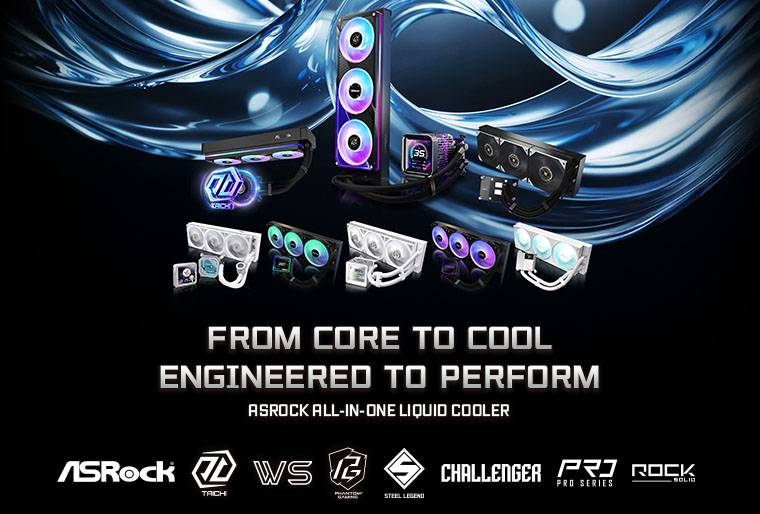
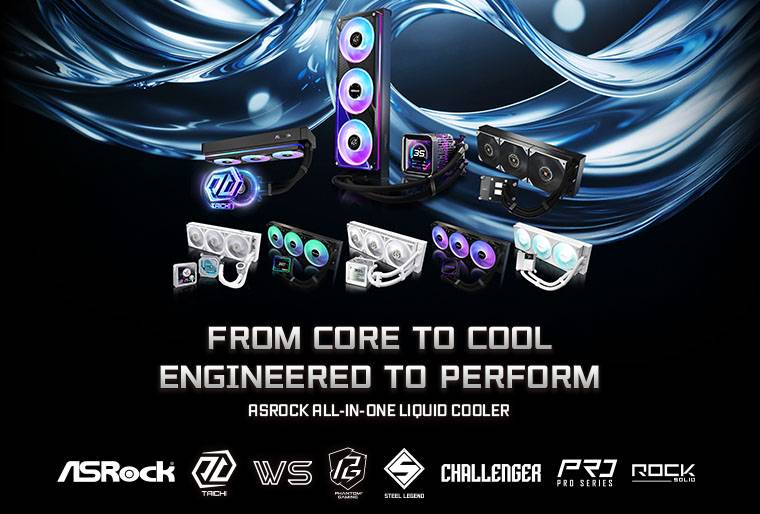
ASRock AIO Liquid Coolers: Designed for Every Cooling Need
At ASRock, we understand that no two PC builds are exactly alike.
That is why our comprehensive AIO liquid cooling portfolio offers different radiator sizes, thicknesses, and cooling architectures to meet a wide range of performance requirements.
From mainstream gaming setups to extreme enthusiast systems and professional workstations, there is an ASRock cooling solution designed for every type of user.
27mm: Steel Legend, Challenger, Pro and Rock Series
For mainstream users seeking dependable cooling and practical value, ASRock offers a range of 27mm radiator solutions.
Challenger, Pro and Rock models provide various 240mm and 360mm options, combining reliable thermal performance with installation-friendly designs.
The Steel Legend 360 LCD further enhances the experience with durable fan technology and a customizable full-color display, making it an appealing choice for users who value both reliability and personal expression.
32mm: Phantom Gaming 360 LCD
Built for performance-driven gamers, the Phantom Gaming 360 LCD features a 32mm-thick radiator engineered to provide enhanced cooling potential.
Together with its high-performance cooling architecture, dedicated VRM cooling module, immersive 3.4-inch LCD, and 360° Halo ARGB lighting, it delivers a compelling combination of thermal performance and gaming aesthetics.
38mm: Taichi AQUA and WS Workstation Series
For enthusiasts pursuing exceptional cooling performance, the Taichi AQUA 360 LCD combines a 38mm high-capacity radiator with a dual-pump architecture and high-performance radiator fans.
Designed for demanding flagship systems, it brings advanced thermal engineering together with distinctive visual design.
Meanwhile, professional solutions such as the WS TR 360D utilize a 38mm high-density radiator and specialized workstation cooling architecture to support sustained heavy workloads and long-term operational stability.
40mm: Taichi 360 HOLO
The Taichi 360 HOLO combines a substantial 40mm radiator with innovative Persistence of Vision (POV) technology, creating a striking floating 3D visual experience.
It demonstrates how advanced cooling design and next-generation aesthetics can come together in a flagship AIO liquid cooler.
Conclusion: The Best Radiator Isn't Always the Biggest
When choosing an AIO liquid cooler, there is no single solution that fits every PC.
A 240mm radiator or a slimmer design may be the ideal choice for users prioritizing compactness and installation flexibility.
For enthusiasts looking for greater thermal headroom, quieter operation under demanding loads, or sustained high-performance cooling, a 360mm radiator or thicker configuration may be worth considering.
Ultimately, the right radiator is the one that best matches your processor, chassis, workload, and personal preferences.
From everyday computing and immersive gaming to extreme performance and professional workstations, ASRock delivers a diverse range of AIO liquid cooling solutions designed to meet every user's needs.